Introduction by Benj DeMott, editor of First of the Month
From First of the Month (October 2025)
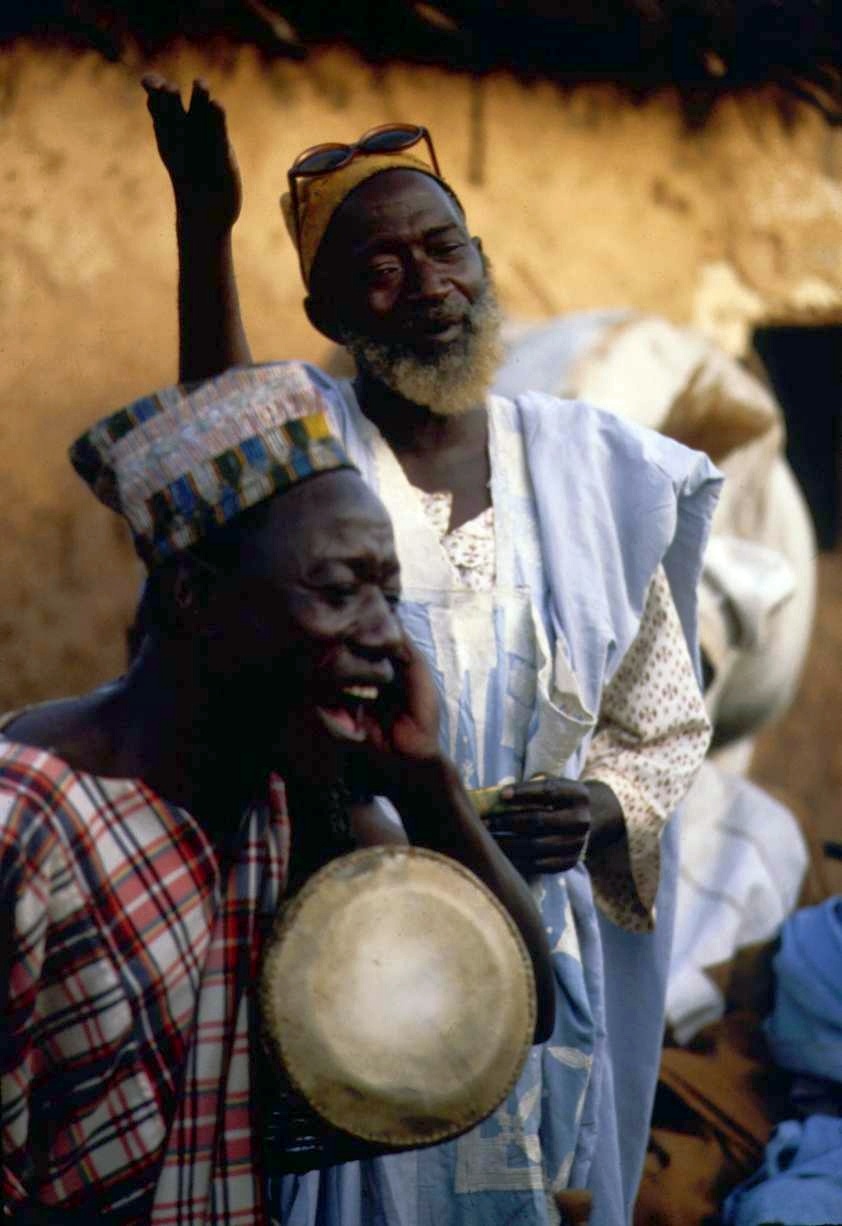
John Chernoff, author of the 20th C. classic, African Rhythm and African Sensibility — “So nice I [David Byrne] read it twice” — has been fine-tuning A Drummer's Testament: Dagbamba Society and Culture in the Twentieth Century for decades. It's a high honor to help Chernoff get word out that the site is ready for the world. Here is A Drummer's Testament's homepage. Per Chernoff (in a note to FOTM):
“A Drummer's Testament” is a fifty-year project done in collaboration with a team of indigenous non-literate and literate Dagbamba intellectuals in northern Ghana, as a translation solely in the words of drumming elders. Their goal was to provide a record for future generations to have access to their cultural knowledge and memories. Beyond its local relevance, the project looks in detail at the value of indigenous knowledge and at how indigenous knowledge is preserved and passed from generation to generation orally and without writing. The traditional drummers of Dagbon embody the commitment and perseverance that are necessary for cultural institutions to persist as a nexus of social action. In contrast to an expensive printed publication, the development of the world wide web has allowed me to preserve that record as an open-access website that is freely available and accessible on phone, tablets, and computers.
Chernoff has evoked (in his introduction to A Drummer's Testament) how certain old people in the streets of Accra embodied the lingering presence of traditional cultures in post-colonial Ghana of the 1970s.
They conveyed to me a sense of their difference from the hectic scene. These people, I felt, have nothing to do with the modern society, yet they projected a sense of security, as if they were somehow more important to what happens around them than was apparent to me. . . . My thoughts on these old people naturally came to be influenced by the qualities that singled them out, the sense of inwardness, self-containment, deliberateness, significance and self-sufficiency that was so incongruous in the ambience of Accra, where connectedness is the do-or-die task of every moment. As they moved through the crowds, they did not bump elbows with others, nor was their progress impeded, as if each had an invisible external aura to clear the way. In their bearing was a semblance of the pace of village life as I had observed it, to whatever small extent at that time. Conventional opinion asserts that such people are anachronisms, that the traditional ways of the village are out of place and must be replaced in the modern urban world, but I felt otherwise, and I was not alone in my perception. Their subtle effect on others was evidenced without fanfare but acknowledged nonetheless in the respect that gave them room on the street, representing a common awareness of the distance between them and what they implied in that type of public place. They did not need Accra; it needed them.1
Chernoff's chief collaborator on A Drummer's Testament, Alhaji Ibrahim Abdulai, was one of those cool elders. Father Drummer knew his own worth: “I have told you that without a drummer, there is no chief.” To quote his bio at A Drummer's Testament, he “believed deeply in the Dagbamba drumming tradition, and at the same time, his eyes were opened onto the world, and he believed that the achievements of Dagbamba culture should be known to the world and were worthy of a respected place on the world stage.”2
Chernoff has long been committed to ensuring Dagbamba culture gets R.E.S.P.E.C.T.:
I have described in various writings the astounding way in which the Dagbamba integrate music into their social and community life. . . . Their music is anchored in epic songs that convey episodes in the history of the six-hundred-year-old dynasty of chiefs, one of the oldest continuous father-to-son dynasties in the world, and perhaps the oldest. These epic songs, part of a body of historical knowledge, are sung at a performance of what Westerners would call a “drum history” but what Dagbamba call Samban' luŋa, literally “outside-the-compound drumming.” At certain times during the year, drummers sing and beat different parts of the Dagbamba drum history in an open area outside the house of their town's chief, who sits with his wives and elders with the populace assembled around them. After the evening meal, while the populace arranges itself, the town's drummers praise their own ancestors in lengthy introductory sections, until one of the chiefs of the town's drummers takes over at around ten or eleven o'clock and sings until dawn. Most of the drum history is recounted through the medium of stories about the lives of past chiefs, their ancestry and progeny, what they accomplished and why they got their proverbial praise-names, which are appellations in the form of proverbs that are used to identify them.
Apart from having a performance context reminiscent of the Homeric epics of pre-classical Greece, the Samban' luŋa informs other Dagbamba musical idioms which branch out into praise drumming and singing that use the proverbial names bestowed onto chiefs. These proverbial names are also applied to descended members of various chiefs' lineages, whether or not the people still have any claim to chieftaincy. The drummers know the family lines of people in their communities, and with the help of drummers, everyone in Dagbamba society can trace his or her ancestry to some point on a chieftaincy line. Drummers sing and use their drums to beat these names and praise people in public places, identifying and edifying them. In effect, music is what lets people know about their family. More than that, the rhythms of the proverbial praise-names are used as the foundations of wonderful drum ensemble pieces for social dancing. More than that again, this dancing is done by individuals inside a circle of spectators at events like weddings, funerals, and festivals. Drummers call a person to dance by beating praise-names of his or her forefathers. A dancer may dance several dances briefly inside the circle, while friends and relatives press coins onto the dancer's forehead or place coins into the dancer's hands. The people who dance to the names of past chiefs publicly demonstrate their relationship to the dynasty and to other members of their lineage segment. This incredible degree of historical consciousness is thus more than a focus for thought: historical knowledge, instead of being learned cognitively or represented through various symbols, is brought down to the level of social interaction, where people embody the residues of souls retained in memory, demonstrating their personal relationship to history by dancing to the very names of their ancestors in musical contexts while others in their community are looking at them. . . . For Dagbamba drummers, the vocation of cultural knowledge and performance offers ways to access their dead people and to perpetuate that possibility.3
The “incredible degree of historical consciousness” manifest in Samban' luŋa (“one that partakes of the deepest abiding themes of African cultures . . . ancestorism, sacrifice and embodiment”) enables Dagbamba to live forward in villages or in concrete jungles like Accra (“I Cry”) where everyday people are under enormous pressure.
The uncertainty and discord of the world are met as personal destiny and resolved through a display of balance and composure that incorporates history as vital presence. This sensibility was evident in the practical morality of both the traditionalists of Dagbon and the young urbanites I knew, who projected respect and patience, gentility and humor, collectedness of mind and a refusal to suffer. These ideals are on vivid and engaging display in the multifaceted artistic performances that help to enrich and sustain their lives.4
Check the post below — an excerpt from a chapter in A Drummer's Testament — about a drummer's preparation to sing the drum history for more on this score. A Drummer's Testament not only talks you through how Dagbamba do it, you can also see and hear how a Samban' luŋa goes down.
Chernoff has advice for FOTM readers on how to enter A Drummer's Testament, proposing that the “issue may be resolved with a random approach: one can start anywhere.”
The quick way in involves the photographic and audio media. Regarding the chapter texts, any chapter is worthy of interest. From how they teach children to use hoes in farming, to how they caught slaves to ransom their captured chief from the Ashantis, to how a drummer prepares himself to sing the epic history, to the historical stories themselves, to how they use proverbs as names, to Alhaji Ibrahim's reflections on the pilgrimage to Mecca, to how they bury chiefs, to how the women co-exist in a polygamous household, to how childbirth is managed and babies are raised, to how they welcome strangers: all are discussed with examples and proverbs.
Chernoff has taken his sweet time when it comes to staging Dagbamba culture. No doubt, his master was in his ear. Here is Alhaji Ibrahim Abdulai's final charge to Chernoff:
The work we have done, hold it with your two hands. Don't hold it loosely. Never let what you hold in your hands to be lying on the ground. If you are trading and you want to sell something, and what you are selling is good or bad, then if it is small, when you take it to the market, you should put it in a beautiful tin and cover it. If somebody comes to say he wants it, then you just open the tin a little way for him to see inside. Whether it's a nice thing inside or a bad thing inside, you don't have to open it wide. You just open it a little, and he will say, “Open it all the way and I will see.” And you will tell him, “Oh? Am I not opening it?” He will put his hand inside and take some and go. And so the talk we have talked and we have all collected in our hands, when you get home, you should try your best. If you get home, don't take it and spread it roughly in America as if you didn't struggle or suffer to get it. Get a beautiful tin and cover it.5
Now that Chernoff is ready to open up A Drummer's Testament, we'll follow his lead in the upcoming months as we steer First readers to words and images and sounds on the site.
Let's step off now with the envoi from the last chapter, “The Receptive,” of Chernoff's introduction:
As easy as it is to lean against a wall, so too is this book easy to read. There are times when the information becomes thick with things you need to know, and you have to involve yourself in the details, but do not be discouraged. You will quickly become used to the rhetoric. The discourse of a drummer moves by simplicity and repetition, and the information will get to you either way. Father Drummer speaks simply and takes you all the way through the simple truths in living. He leads you on, and he moves on. . . .
If something is confusing, relax and let the current talk's meaning emerge through its flow. It is useful to revisit the Yoruba image of culture as a vast cloth too wide to tie its ends together. In that sense, you might be advised not to treat this work as a book that you can grasp and comprehend as a whole. Find your point of entry and branch outward, forward or backward. When you go to another place, you will be reminded again how things relate. You can read parts of it out of order and return to a place you left. Take a half-hour or an hour to read any chapter on its own. It is all right to read this book in bits over several years; after all, it took that long to talk it. When you have to stop reading it, you have to stop. If you like, leave it for some time. You can come back to it later. . . .
You are going on a journey, and you are going to meet a great man. Alhaji Ibrahim Father Drummer based his life and ethics in an institutionalized complex of art, family, politics, history, and community. In Dagbon there are people being trained to carry it on. For us in our time, it does not move the same way: the thing is internal and spiritual, yet its creative complement tends outward. It is accessible because the essence of our Father Drummer's traditional sensibility, the essence of his humanity, is a continuing moral focus that links character to culture. Thus did he align himself with the creative forces in life.6
Addendum: There's a portrait of Alhaji Ibrahim Abdulai — and a youngish John Chernoff — in the photo gallery of “Co-Authors and Research Associates” here.7 Included in the gallery is the picture of another master drummer/Research Associate, Alhaji Adam Mangulana, whose image seems perfectly aligned with “the creative forces in life” instantiated in “A Drummer's Testament.”8
Notes
1. https://adrummerstestament.com/1/Intro_3_Relative_Systems.html ↑
2. https://www.adrummerstestament.com/Co-authors.html#Alhaji_Ibrahim ↑
3. https://www.adrummerstestament.com/1/Intro_4_The_Anthropological_Heritage.html ↑
4. Ibid. ↑
5. https://www.adrummerstestament.com/3/3-27_Reflections_on_the_History_of_the_Work.html ↑
6. https://www.adrummerstestament.com/1/Intro_11_The_Receptive.html ↑
7. https://www.adrummerstestament.com/Research_associates.html ↑
8. Alhaji Ibrahim Abdulai once confided to Chernoff that if Alhaji Adam Mangulana came to your village or town back in his prime, “on that day you no longer had a wife or girlfriend.” ↑