An excerpt from A Drummer's Testament: Dagbamba Society and Culture in the
Twentieth Century
by Alhaji Ibrahim Abdulai, John M. Chernoff, et al.
Chapter 9 in Volume II (“Old Talks”)
Introductory notes by Benj DeMott, editor of First of the Month
From First of the Month (September 2025)
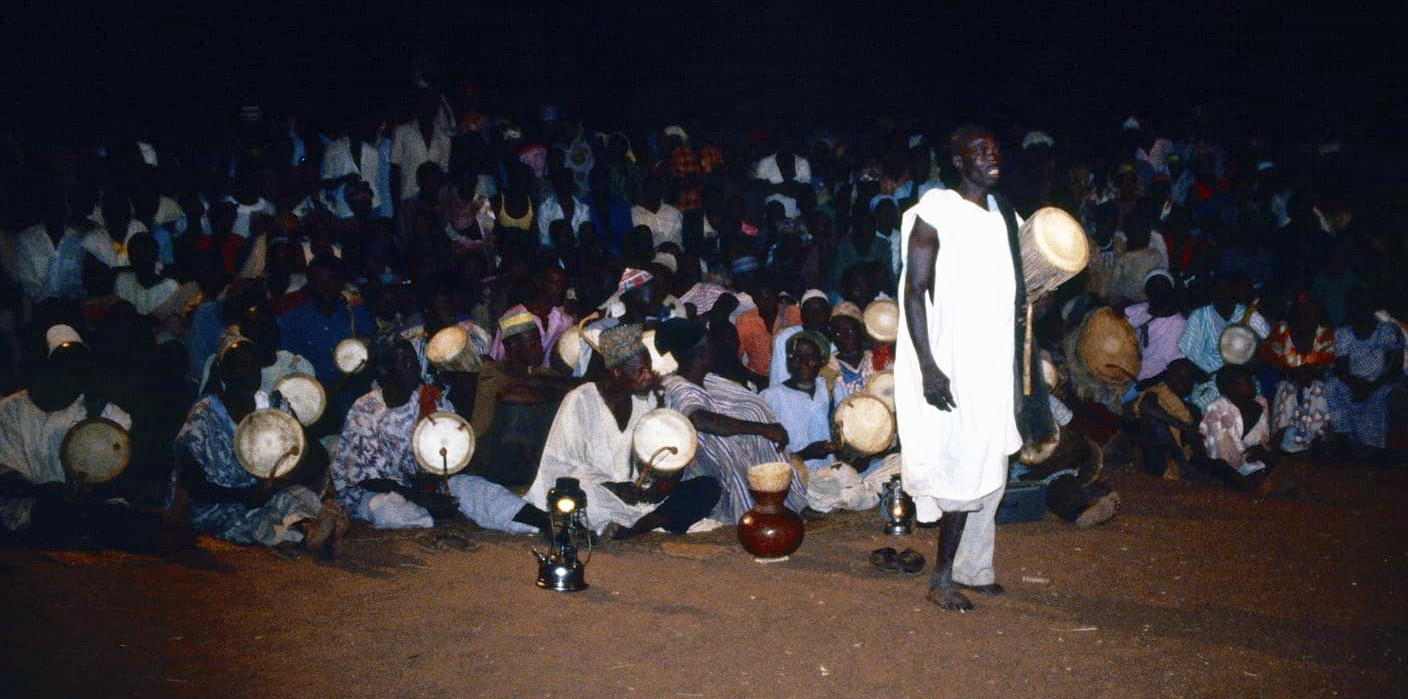
The place fills with people. There are lanterns and recorders in front of the drummer who will sing the drum history.
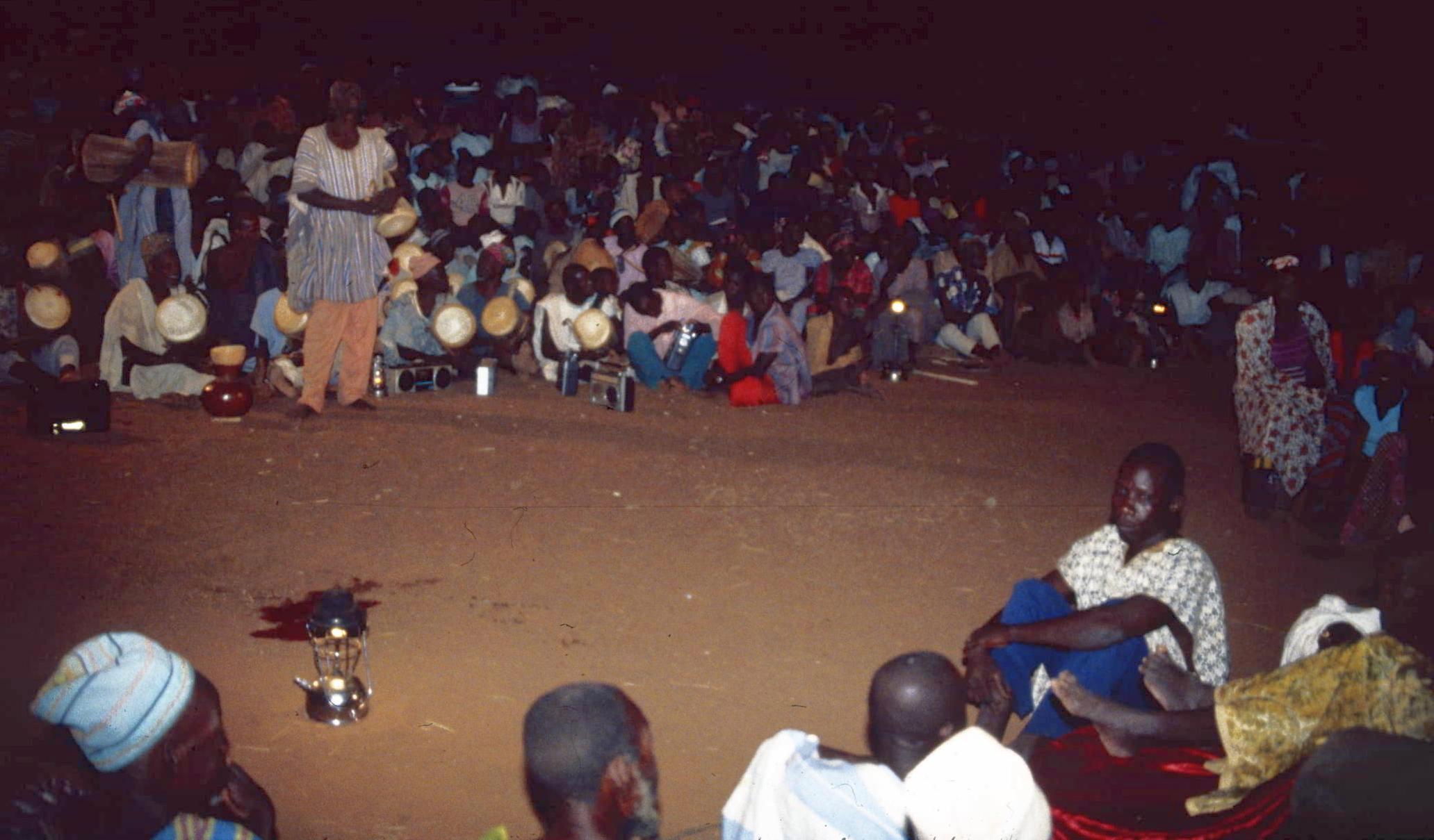
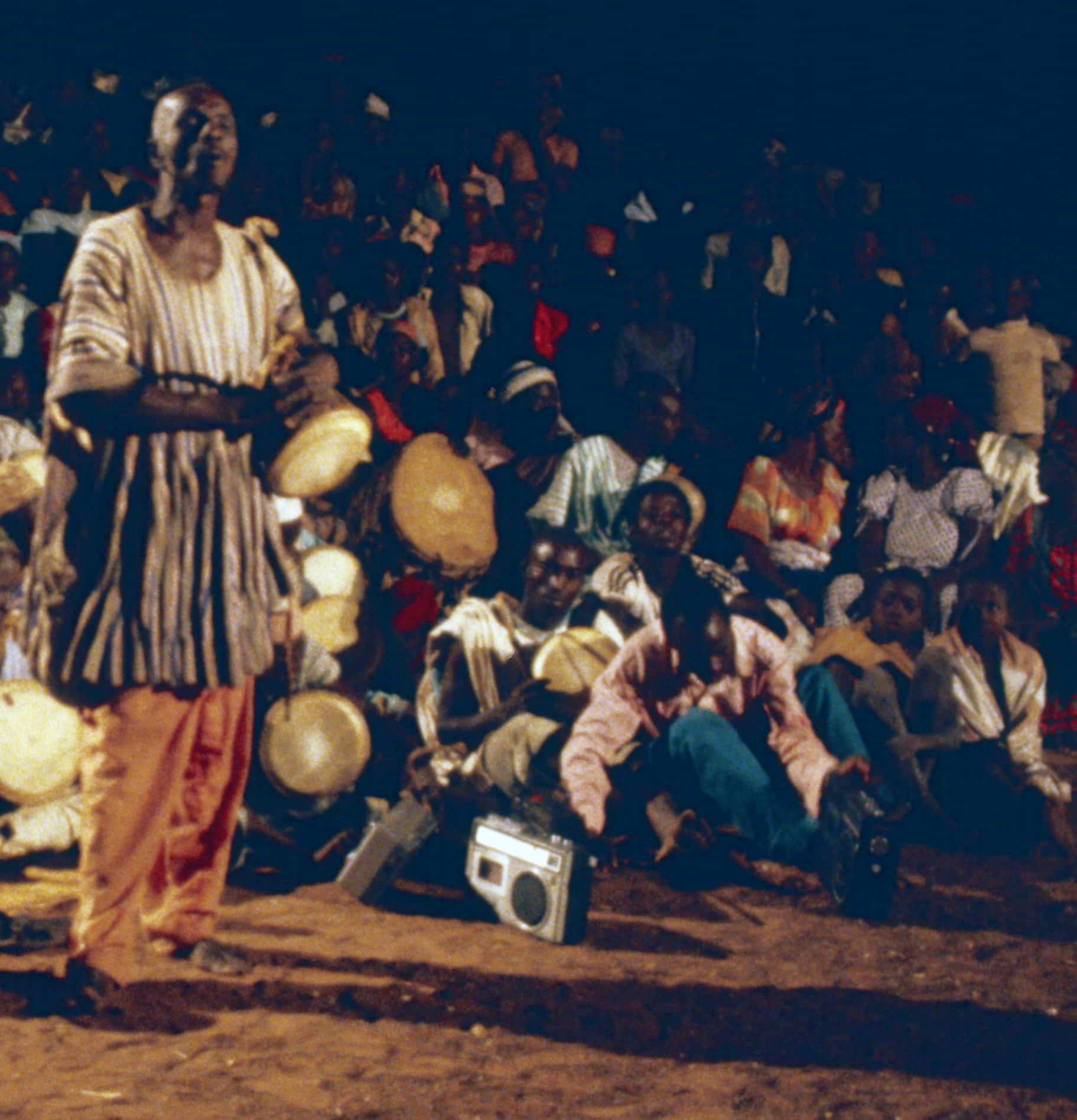
The History section of A Drummer's Testament includes chapters with stories of important chiefs of the 17th and 18th centuries. To get a sense of what a drum history sounds like, here is an excerpt that includes singing and transitional sections.
What follows is a swatch of the chapter on the drum history that focuses on what a drummer does to learn the history and prepare to sing it.
And so the Samban' luŋa is there because of the chiefs, and it is the chief's drummers who beat it. All the chiefs of drummers are there because of the Samban' luŋa. Anyone who becomes a chief drummer, if he cannot beat the Samban' luŋa, then at least he will have a child who can beat it. If you are a chief of drummers, you have to have people. If you cannot beat Samban' luŋa and you don't have a child who can beat it, you will never become a chief of drummers. How my brother Mumuni [Alhaji Mumuni, one of the project's co-authors] is in Savelugu, the youngmen drummers take him as their elder, and they sit with him in the night to ask him questions about drumming. Their leader, Issa [later Saakpuli Lun-Naa Issa, one of the project's consultants], is the child of Palo Yiwɔɣu-Naa Karim. In all of Dagbon, this Issa is respected as a singer, and Mumuni is teaching him more. And again, I told you that Mumuni has refused many drumming chieftaincies, but how he is in Savelugu, he is standing as the brother of the Palo-Naa who is sitting [Palo-Naa Issa, a principal research elder]. If a festival day comes, and it is that Palo-Naa is the one who is going to beat the Samban' luŋa, if he's not strong to beat it, he can call Mumuni and say, “Mumuni, go and sit outside and beat the Samban' luŋa for me.” And if the drummers are many, there are his brothers and his children to help. It's not that the Palo-Naa doesn't know how to beat it: Palo-Naa is the chief of the drummers in Savelugu, and he knows how to beat it. But if Palo-Naa cannot go to some place, he can send my brother Mumuni to go there; and so as my brother is sitting, he can beat the Samban' luŋa. If Mumuni does not want to beat it, he will just tell Palo-Naa plainly that his knowledge is not up to sitting to beat Samban' luŋa. Then Palo-Naa will call another one, and he will tell the fellow that your brother so-and-so, or your junior father so-and-so, said that he cannot take my position to beat the Samban' luŋa, and so as it is now, you are the one I'm going to tell to go and sit the outside for me. That is how the Samban' luŋa is.
If the child also wants, and he has the knowledge, then he will go. How he is going to go and sit there, this very Palo-Naa will also come outside the chief's house and sit down. The child who is going to beat it, he too, he has a swearing that he will swear before he will beat it: “I'm going to do the work of my father. And so it is my father who gave me this work. I don't say that I know too much. It is by force that I am going to do it.” This is what the child will say and he will beat the drum. It is because some drummers can do bad things. There is a type of medicine we call kabrɛ: tying. They can tie a drummer who is going to beat Samban' luŋa. You the one who is going to beat it, you won't be able to talk. It is inside drumming. If you are not strong, and they tie you this kabrɛ, when you go there, you can't open your mouth. It isn't that you the drummer don't know it, but it is just wickedness. And so to beat Samban' luŋa is hard. That is why the drummers fear it. And so drummers also put medicine inside their body to protect themselves against anyone who will try to do them something bad, and it won't catch them. It is there like that. And the old drummer will also come and be sitting down behind the back of the one the beating the Samban' luŋa, and if anyone who carries any bad thing to do to him, this older drummer will see it.
Inside the Samban' luŋa, there are many talks. There are some of your fellow drummers who won't spare you a free chance like that to do it. Even some good ones, those who want that position, when they see you like that, they won't leave you. That is why they will send an older drummer to be guiding you. And you will be beating and swearing. You don't show that you fear, but truly, it is something you fear. You are swearing by your father's name. You are swearing because of your father's work. And so it is like praying. As I have told you, a drummer's work is a work of prayers. If you are beating Samban' luŋa and you make a mistake in the way you are talking, will they just let you talk wrongly like that? They won't. And so this is the way of Samban' luŋa. And when they catch you making a mistake, they will say bad things to you. And truly, when they say bad things to you, it pains. As for Samban' luŋa, when you make a mistake, it shows your ignorance. Everyone who is sitting will see it.
As for the Samban' luŋa, its talks are too much. And the reason why all the talks inside it are too much is that the talks show the things that happened in the old days. Inside the Samban' luŋa, you will know how the Dagbamba chiefs began. You will know the first chief. You will know from where the Dagbamba originally came, and how they came to stay where they are today. All of this is inside the Samban' luŋa. Even the quarrels that happened between the chiefs, and some of the war talks, they are all there. Because they call it Samban' luŋa — outside drumming — it is actually outside. The way the drummer will come outside the chief's house, everybody will gather there.
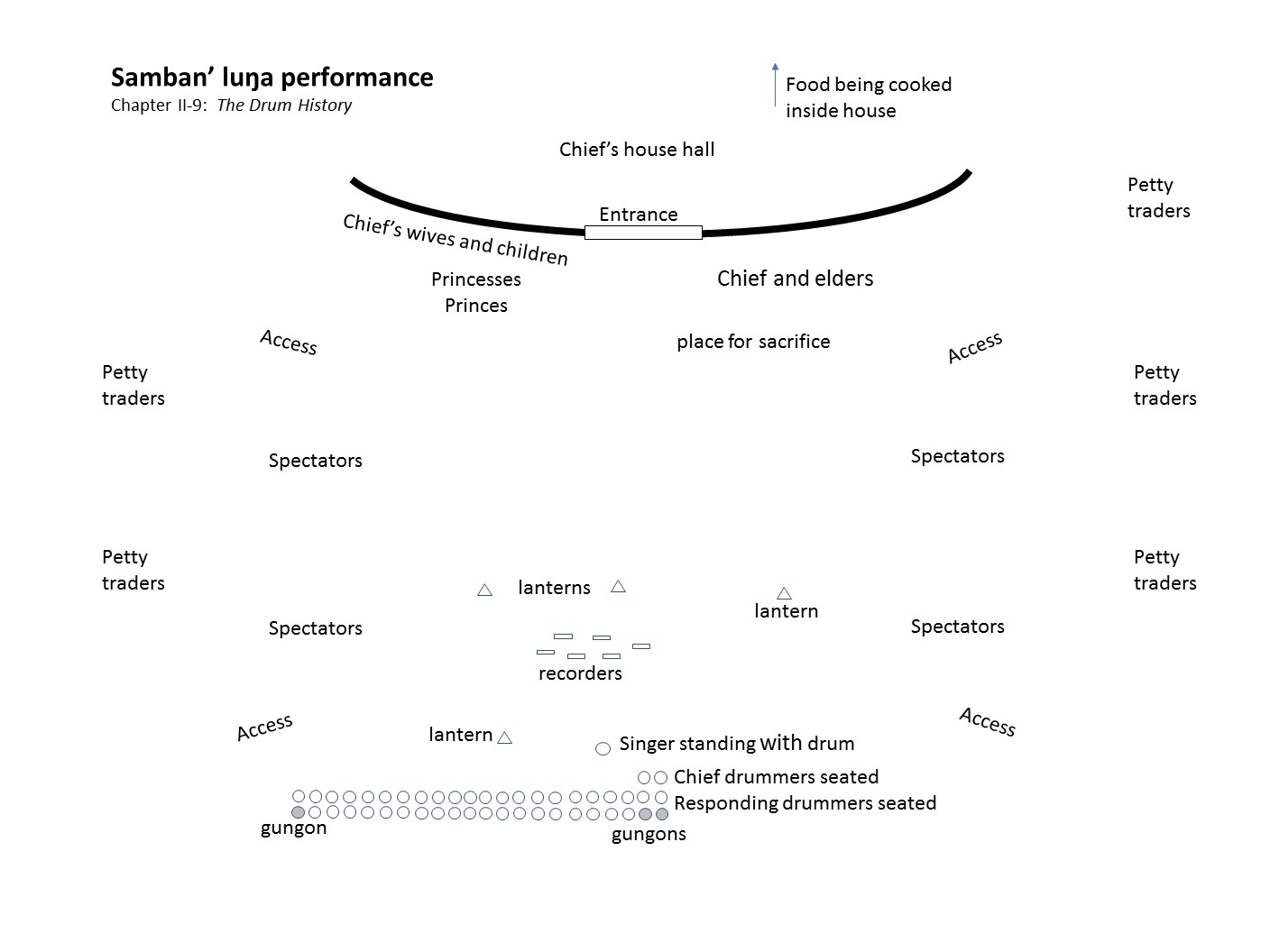
And where everybody gathers, they want to listen and see whether you are telling the truth or you are telling a lie. And some people come there just because they want to see the drummer being disgraced. And some other people too will come there to see the truth he has. If they hear that you have talked rubbish, they will tell you. If you have talked truly, you will be hailed. This is the way it is.
And so a drummer who is going to beat Samban' luŋa, when it comes to your turn as a first timer, your elders will also teach you. You will have someone behind you, and as you are singing, at every point where there is something, your senior will nudge your back. When he nudges you, then you know that this is a difficult place to talk, and you have to be careful. And so when your senior nudges your back and you know there is something difficult, you will calm your heart. You have to be careful at that place so that your talking will be good. That is how you learn Samban' luŋa.
Apart from that, drummers have some other ways. The way you will go and learn it, you will let somebody teach you like a song. He will be singing it, and you will be following him. And you, when you are at home, you have to keep practicing. And sometimes you will go to a respected elder, and as you are sitting with him, you will ask him, “What is this? What is that?” And he will tell you about it, and you will write it down, or you will let someone help you record it. And so you go to many people. And you will take all that they have told you, and you collect them together, and you see what they have said. As you are sitting and you see they agree with each other, then you know it is the truth. And so as you are going to learn Samban' luŋa, you will take time to go to many different people to hear.
Any new drummer, when they tell you that you are coming to beat Samban' luŋa, you will think of it and fear. And at that time you will be at your house, and you will be hearing the old talk inside your ear, that you are going to talk this and that. You will be going over and over it inside your heart, and sleep will not come to your eyes. And this is what a drummer does when he is going to beat Samban' luŋa. When he goes to where they are beating, he is afraid. But when he gets there, he takes the swearing to hold his heart. And then the words will come out.
And it has two ways. There is another way again. The way the young drummer knows it already, and he has been practicing it at home, when he gets there, sometimes the words that come out of his mouth are not the words he had been practicing. It is the words that he hears deep inside him that will come out. The elders say that it is the dead people of the drumming house that help him. They say that it is the dead who will open his mouth. If you believe, that is how it is. If you don't believe, let it be. But that is what they say. And it is inside the drumming. If you go outside Dagbon, you won't find it.
And so inside drumming, someone who is learning to beat Samban' luŋa, he can beat it, and then he stops. But someone who truly has the spirit of drumming, he goes on and on. You will hear him talk and talk, and he won't stop. The talks are coming to him. And so we have people like that. And we know them. And we respect them very much.
And so it is only some drummers who learn much of the Samban' luŋa. As I have told you, if you are going to talk the old talks, first you have to know the talks. And you have to know the proverbs. And when you go and stand there, if you don't know the proverbs, then the old talks won't come. If you don't know the talks, you can't beat Samban' luŋa. And so the person who will beat Samban' luŋa, he has to be someone of knowledge. That is the only way.
And so the drummer who is going to sing at the Samban' luŋa place, when they finish pounding and the food is ready, they will take some and put it in a bowl, and they will add some soup to the side. And they will put it and leave it somewhere for the drummer. It's not that they will prepare special food: it is the same food that everybody in the chief's house is eating. They will just take some and put it aside for the drummer. And you won't go and eat it right away. You will wait until after you have beaten. After you beat the Samban' luŋa and you come back to the house, then you can eat. It is there like that. And so this is how the Samban' luŋa is. This is what a drummer does to learn it and to beat it. If you want to beat it well, you have to suffer. There is no shortcut.